

Wood pellets and briquettes
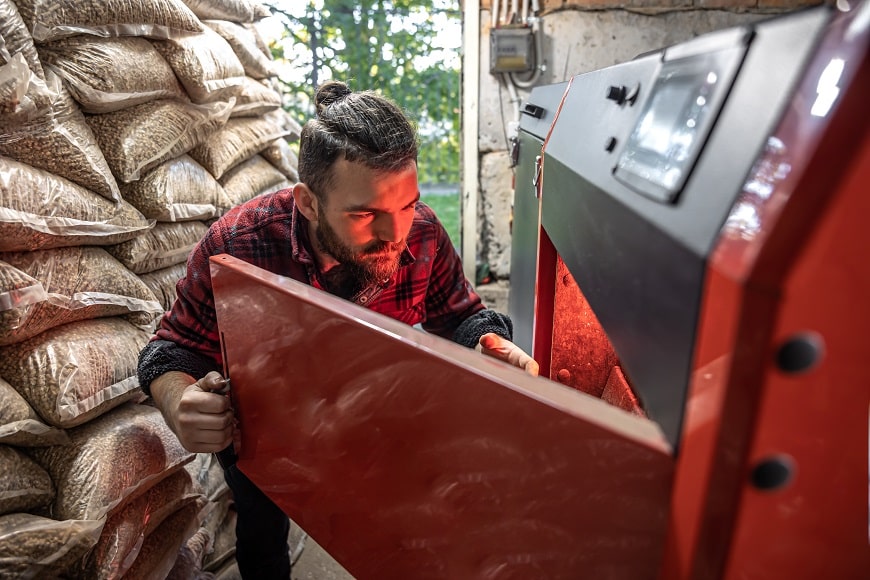
WHAT IS WOOD PELLET FUEL?
Wood pellet fuel – this is an alternative to traditional heating.
Wood pellet is a modern, ecological and economical alternative to traditional fuels used for heating residential houses, companies and public buildings. Pellet may be produced out of various types of biomass: wood from energy crops, waste wood, bark, seeds, nut shells and straw. Wood pellets are the most effective fuel. We use post-production remains coming from sawmills and carpentry workshops. Raw material i.e. sawdust is dried and compacted under pressure to form small granules.
Given the energetic properties of pellet fuel, it must be among the most efficient sources of energy. The calorific value of wood pellets is approx. 18,17 MJ/kg. The low content of moisture in wood pellet makes it more efficient fuel than wood.
The benefits of using pellets as a source of heat are as follows:
– savings compared to other fuels
– comfort of use: purity of storage, use and transport
– high energy value (2 kg of pellets = 1 litre of fuel oil)
– convenient packaging - 15-kg bags or big-bag
– you see what you purchase: get to know the exact weight of a given product, its moisture and ash content after combustion
– easy storage – just provide a dry room and put bags on pallets. For very large investments it will be useful to use a silo for pellets
– to heat a single-family house you need 5 to 8 tons of pellets for one heating season. This amount depends on an area, or rather volume, of your house, thermal insulation, boiler efficiency and weather conditions in winter
– safety in use, transportation and storage
– ecological origin and no environmental pollution in the production process
– low CO2 emission levels at combustion
COLOUR VERSUS QUALITY OF WOOD PELLETS
It is often said that good-quality wood pellet fuel has the colour of light wood. There is some truth in it.
Wood pellets should be made from sawdust i.e. from wood. If you see small pieces of other materials (e.g. plastics) within, it certainly is a sign that we have not got good-quality pellets. In this sense, the colour of pellets is of relevance. Moreover, the best pellet fuel is produced from bark-free wood because bark contains sand impurities.
The colour of pellets also depends on the type of wood used for production. Walnut, cherry, chestnut and oak are much darker in colour than pine or birch. So it is hard to expect that light pellet fuel is to be produced, although its characteristics are equal to pellet fuel made of light wood. Equally often wood varies in colour within an individual tree type. So it is difficult to find two boards with exactly the same colour. The colour of pellets may therefore vary depending on a given production batch with no effect on its quality.
HOW TO RECOGNISE GOOD WOOD PELLETS?
Just like with any other product, when you select pellets you should reach for the good quality product. The EU standards do not let to produce pellets from laminated wood panels containing glues, paints and plastics because during combustion they produce chemical compounds which are harmful to your health and the environment.
When you use poor-quality pellets it may also cause damage to your furnace.
Most often good-quality wood pellets can be recognised by the easiest and most popular method – visually. Just take a look: if granules are not crushed and you cannot see any impurities within, that's fine.
Pellets should contain only wood only, with no artificial binders. So you can also test it by smell - when pellet fuel is combusted, your boiler-room should smell wood and nothing more.
It can be done even simpler. It is worth purchasing “EN plus A1” certified pellets. Then we are sure that each and every product batch is subjected to quality control. The following parameters are checked: granulation, content of fines, mechanical strength, bulk density and calorific value.
Quality of wooden pellets versus furnace parameters
Even the highest-quality pellets may not be best combusted in your furnace. Much depends on your furnace itself and its parameters. It is worth having a try of pellet fuel and adjust your furnace settings to it or ask your installer to set it.
WHY IS WOOD BRIQUETTE ECOLOGICAL?
Zero CO2 emission level
Each type of wood when combusted is characterised a zero balance of carbon dioxide emissions. It means that a tree during its growth in the process of photosynthesis takes the same amount of carbon dioxide from the atmosphere as it releases when combusted. Thus, wood when combusted does not contribute to the expansion of the ozone hole.
Lower content of harmful substances
When compared to fossil fuels wood (when combusted) releases far less harmful substances (such as sulphur compounds and ash) into the atmosphere. Wood is the least harmful fuel taking into account emission levels. And this is not about the widely-comprehended ecology. Heating our house with ecological fuel has an impact on our family, because we breathe in smoke which is emitted by our own stoves.
We do not cut out trees
Wood residues from sawmills and carpentry plants are used as raw materials for wood pellets. It means that we do not cut trees to produce pellets.
WHAT IS WOOD BRIQUETTE?
Wood briquette – just like pellets – is made out of shredded wood waste. Briquette can be successfully used at traditional fireplaces and replace firewood. The low content of moisture causes that the calorific value of briquettes is higher than the one of wood.
The density of wood material in the production makes briquette combust gradually and slowly. Briquette is a dry type of fuel and this is its most important advantage. Wood must be aged to combust well. 1 ton of briquette is equivalent to 4 cubic metres of dried, ready-to-combust wood. It is worth remembering that wood purchased per cubic metre include loosely stacked logs. So as a matter of fact we do not how much wood we have actually paid for. Moreover, when you purchase wood you have to take some efforts to rearrange, age and dry, preferably for 1 up to 3 years. And briquette when purchased is ready to use immediately.
Its moisture (10% at maximum) is another advantage. To compare, aged 3-year wood has its moisture at 15-20% and dry wood fuel has a higher calorific value.
Using this link, you can quickly and conveniently place an online order for wood pellets and briquettes at LIGNO.
Leave your feedback Cancel reply